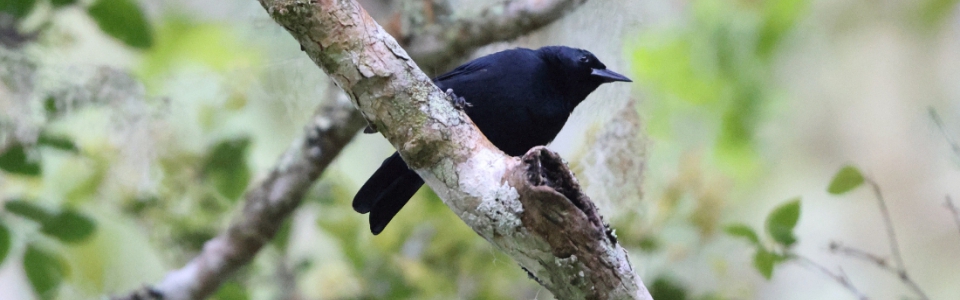
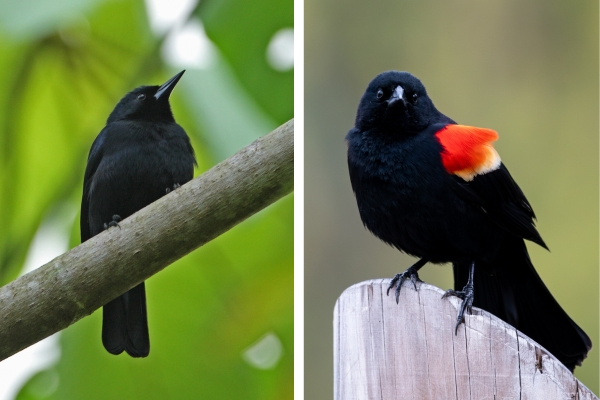
At first glance the blackbird looks, well, like a blackbird. It’s a fairly close relative of the familiar Red-winged Blackbird, though it lacks its cousin’s colourful ornaments. It’s the Jamaican Blackbird’s behaviour, though, that sets it apart from its family members
Islands tend to host unusual birds, as their isolation limits the inflow of species from other places. The island of Jamaica, in particular, lacks birds that forage by probing in bark and vegetation, like creepers and woodpeckers. This leaves a niche open, and the Jamaican Blackbird has opportunistically evolved to fill it.
Unlike other blackbirds that forage on or near the ground, the Jamaican Blackbird spends its time in the tree canopy. In its arboreal habitat it creeps along tree trunks and branches, probing into cracks and crevices in search of insects. It’s a bit like a blackbird with dreams of being a woodpecker.
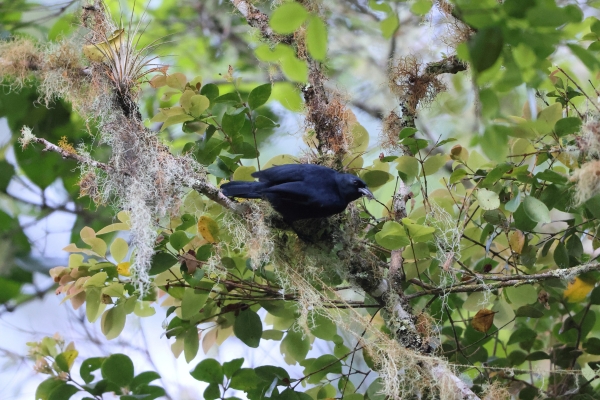
Jamaican Blackbird foraging
The Jamaican Blackbird shares more than behaviour with the woodpeckers, too, as its short legs, long claws, and stiff tail facilitate its creeping locomotion. It also has a long beak, with strong jaw muscles for spreading the beak apart to widen openings. It can even hammer like a woodpecker, if not with quite the same power.
The blackbird often locates its food under tree bark, but its most lucrative foraging opportunities are provided by bromeliads and other epiphytes: plants which grow on the trunks and branches of trees. These unusual plants are the basis for a rich, off-the-ground community, attracting insects to both their flowers and the water that collects in their leaves. For a Jamaican Blackbird, they are a veritable bug buffet.
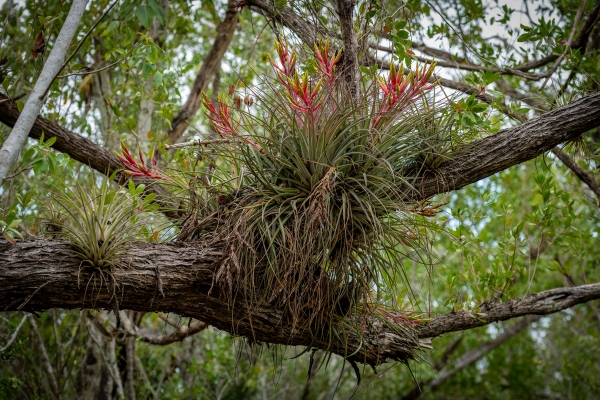
Blooming bromeliads on tree brances
These birds even utilize epiphytes for their nests, which are built from the stems and roots of epiphytic plants, including orchids. The nests are typically tucked beneath bromeliads, providing shelter from the elements and concealment from would-be predators.
For these reasons, Jamaican Blackbirds rely on mature forests with big, old trees which support a lot of epiphytes. These forests are naturally limited in Jamaica, but are also heavily impacted by human impacts like bauxite mining, charcoal production, agriculture, logging, and forest fires. As a result, the Jamaican Blackbird is an endangered species.
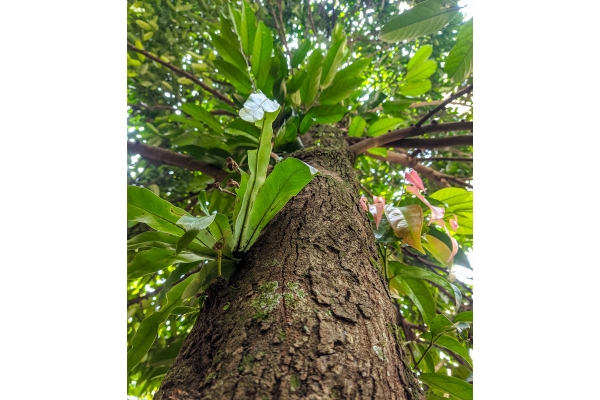
Epiphytic plants growing along the bark of a tree
Fortunately, the Blue and John Crow Mountains National Park protects a substantial chunk of mature forest, and accordingly a population of Jamaican Blackbirds. Others can be found in Cockpit Country, where efforts are underway to stop bauxite mining. Protection of the bird’s existing habitat is vital, as old, epiphyte-laden trees can’t be reproduced in short order.
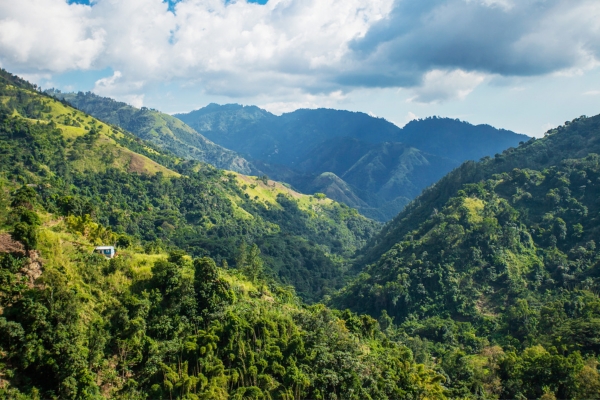
Blue Mountains in Jamaica
The Jamaican Blackbird is notable for its unusual adaptations to the island conditions in which it lives, but it is also a valuable reminder of the complex relationships between species and their environment. The blackbird doesn’t just live in trees, it relies on forests which have had the time and space to develop into rich, diverse communities. It is certainly emblematic of this habitat, but there are many other species who also rely on it too.
With sufficient protection efforts, the Jamaican Blackbird and its forests can survive and thrive into the future. That’s good news for visitors to Jamaica who want to see maybe the strangest blackbird that exists. Rest assured that it is a truly wondrous experience.
We can hope to spot the Jamaican Blackbird and other alluring birds on our Discover Jamaica tour in 2027, led by Ann Haynes-Sutton and Josh Vandermeulen.