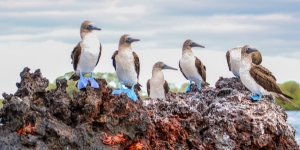
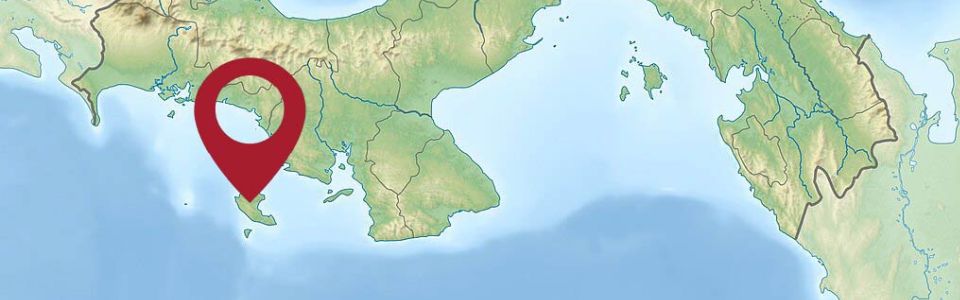
Just as Ecuador has the Galapagos — an islands-based national park off its Pacific coast — Panama has Coiba. The islands of Coiba National Park lie just tens of kilometres from the Panamanian mainland, but they feel a world apart. The park is a paradise for nature lovers, with incredible wildlife and ecosystems both on land and in the water.
The largest island in Coiba National Park is Coiba itself. From the early 1900s to the early 2000s, it was home to a penal colony with a reputation for brutal conditions and violence. While not possessing a pleasant history, the prison made further development of the island impossible and restricted access to the public. This meant that the natural resources of Coiba remained relatively preserved, with nearly 80% of the island forested and undisturbed today.
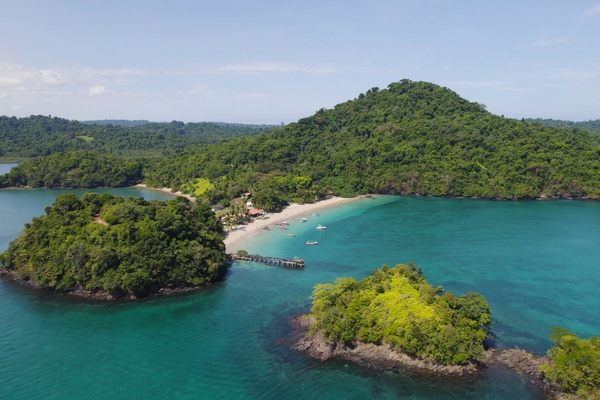
Coiba Island
In 1991, even while the prison was still operational, the Panamanian government established Coiba National Park to preserve the unique natural resources on and around the islands. The park protects 39 islands and their surrounding waters, covering an area of over 270,000 hectares. In 2005, a year after the prison closed, Coiba National Park was declared a UNESCO World Heritage Site, recognizing its significant natural value and conferring international protection.
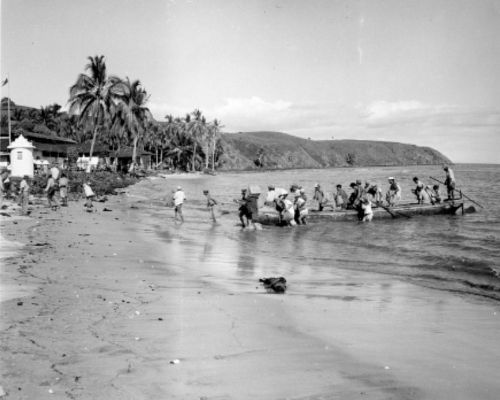
Convicts arriving on Coiba Island on January 15, 1956
Photo taken by Smithsonian Secretary and ornithologist Alexander Wetmore
The pristine forests of Coiba are home to a wide array of species found on the Panamanian mainland, but with a bit of a twist. The islands separated from the mainland over 10,000 years ago, and that long isolation has allowed some of the resident species to diffrentiate from their neighbouring ‘cousins.’ This has given rise to several species and subspecies found nowhere else in the world, including the Coiba Spinetail, Coiba Howler Monkey, and Coiba Agouti.
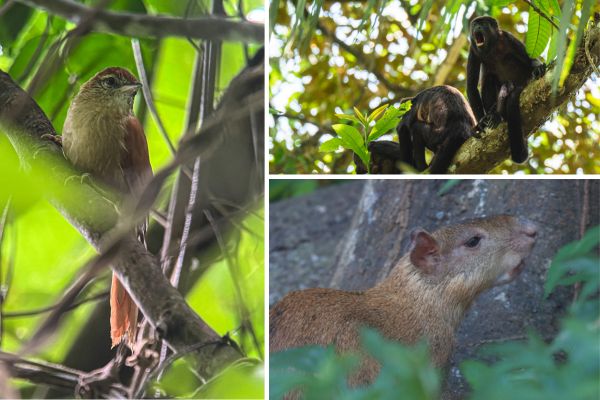
Coiba Spinetail (left, credit: Roger A. Morales-Flores), Coiba Howler Monkey ( top right), Coiba Agouti (lower right)
With a great deal of development pressure on the mainland, the quiet islands of Coiba have also become a refuge for retiring species, which have become difficult to see elsewhere in Central America. Spectacular Scarlet Macaws abound here, though they are rarely seen in continental Panama. Enigmatic Crested Eagles also call Coiba home, satisfying their preference for old-growth tropical forest with little disturbance.
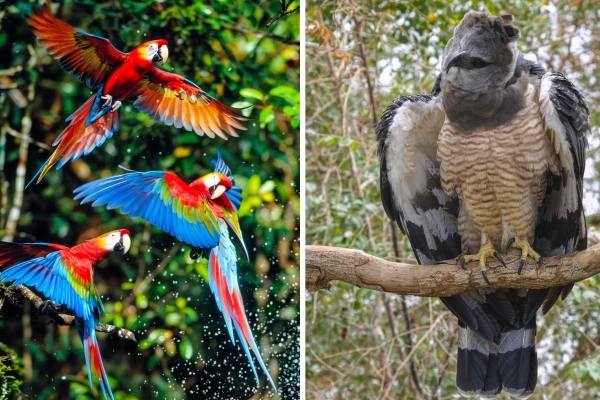
Scarlet Macaws (left), Crested Eagle (right)
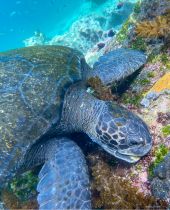
The true treasure of Coiba, though, is beneath the waves. Coiba’s Special Zone of Marine Protection is home to over 750 species of marine fish, including 33 species of shark. It protects spectacular coral reefs, harbours a diversity of marine mammals such as Humpback Whales and Pantropical Spotted Dolphins, and supports Hawksbill and Green Sea Turtles, which swim in its waters and nest on its beaches. Poaching is still a concern, but in recent years, a considerable effort has been made to enforce the protection zone and stop illegal harvest.
Ecotourism is becoming the new normal for Coiba National Park, and the Panamanian government along with the Smithsonian Tropical Research Institute and local groups, is working to ensure it follows a sustainable path. Snorkeling, diving, and hiking provide excellent opportunities for experiencing Coiba’s unique communities both on land and in the water. All visits must be arranged with the park in advance so that their impact can be kept to a minimum.
Coiba National Park is a shining example of a country recognizing the value of pristine natural resources and seeing an opportunity for conservation in an unlikely place. A prison may have protected the islands for the last century, but ecotourism and a concern for the natural world can preserve it for the next century and beyond. If you have the opportunity to explore Coiba, it’s a place you definitely shouldn’t miss.
Visit the Coiba National Park on our Costa Rica & Panama Canal Expedition in 2027. View more details here.